Saturday, March 29, 2014

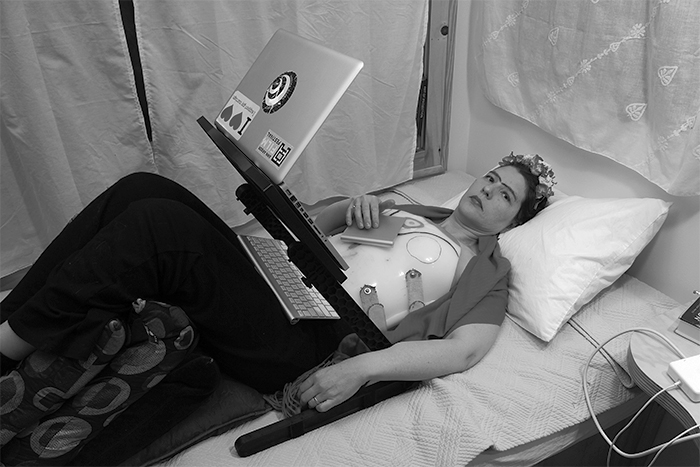
Bedroom office...

I was thinking about technology and capitalism interfering with our sleep and did a simple Google search...the guy on the chair made me laugh more than anything for some reason. I suppose I never really thought about reclining office chairs, but (thinking about it) they're actually pretty good examples of what we're talking about. To sleep at work would mean you're overworked and/or you don't value sleep enough to go to a proper bed for it. Maybe you can't?  Also, this necessity of having a computer in your bedroom. Why? Why does everyone in the house need one? Why are computers in bedrooms and not elsewhere? Maybe it comes down to space, but it often doesn't. Anyway, just thought I'd post.


Friday, March 28, 2014

'We are concerned with battles or games between the strong and the weak, and with the "actions" which remain possible for the latter': Some notes on Michel De Certeau's 'Making Do'.

De Certeau argues that in contemporary society work and leisure appear to 'flow together.' This point is arguably becoming even more valid, the further society 'progresses' - the more smart phones/tablets keep us 'logged in' and 'switched on' at all hours of the day, with no real distinction remaining.

His response to the all-encompassing nature of state power is to promote attempts at 'making do', or in other words, 'ways of using the constraining order.' (p. 30) Establishing some agency and creativity within a system that attempts more and more to train us to forget he posses these powerful tools. He gives the example of making laws, practices and representations 'function in another register...[the person thereby remaining] other within the system.' (p. 32)

He thinks the approach from those who currently document, analyse people (philosophers, journalists, historians, political theorists(?)) ignores this way in which people can use the hegemonic practices they are forced to abide by. He reminds the social sciences that they 'belong to the system which they study' (p. 41) and thus cannot claim an objective view point. He therefore credits the human with much more autonomy than, for example, early Foucault and his insistence that the individual is merely a result of the discourses to which he is subjected: 'the consumer cannot be identified or qualified by the newspapers or commercial products he assimilates: between the person (who uses them) and these products (indexes of the "order" which is imposed on him), there is a gap of varying proportions opened by the use that he makes of them. ' (p. 32)

One of the problems De Certeau highlights in gaining this agency in the present day, is the negative effects of technology: 'The child still scrawls and daubs on his schoolbooks; even if he is punished for this crime, he has made a space for himself and signs his existence as an author on it. The television viewer cannot write anything on the screen of his set. He has been dislodged from the product; he plays no role in its apparition... [he is] a pure reciever' (p. 31)

Whilst those in power can utilise strategy, forward planning, and therefore ultimately, probably outmanoeuvre any large-scale attempts at change, there are weaknesses in the way the state functions.... put simply, 'power is bound by its very visibility.' (p. 37) Ultimately, then, state power tends to 'privelage spatial relationships' (p. 38) Tactics on the other hand (the name he gives to those attempts to rupture the omniscient appearance of the state) can, to counteract this, utilise time, rather than space. Seizing opportunities for 'making the worse argument seem the better' (p. 38)

De Certau describe those who 'make do' as 'poets of their own affairs, trailblazers in the jungles of functionalist rationality' (p. 34) So, rather than seeing progressive politics in terms of 'the little people' up against the 'monstrous power' of the state, De Certeau emphasises that a tactic might actually gain 'perspicacity through it's blindness,' (p. 38) in other words, those without power see things differently, and this is an advantage, even a privilege.

Actions taken by those attempting to subvert state power are only seen as meaningless because 'they do not cohere with the constructed, written and prefabricated space through which they move' (p. 34) He talks about how cultural techniques 'camouflage economic reproduction with fictions of suprise'  (p. 29) What I take this to mean is that we only get the illusion of surprise, or transgression in our day to day lives, as state power is so ever-present, and the only real motive for everything is economic growth, it seems to prevent anything entirely out of the ordinary happened. This reminded me of a more recent quote from Slavoj Žižek: 'we feel free because we lack the very language to articulate our unfreedom.'


In this sense, I can see similarities with Hegel's theory of the dialectic, notably discussed in a recent book by Bruce Gilbert entitled 'The Vitality of Contradiction'. He argues (from a traditional Hegelian perspective) that we 'outgrow' political structures by 'learning from them,' that is, 'we go forward by pushing against ourselves.' And therefore, human creativity promises change. As De Certeau describes little subversions/uses 'like the snowy waves of the sea slipping in among the rocks...[can defile] an established order.' (p. 34) A slow process of gradually overcoming.


The metaphor is a useful one - nature proves how something that seems immovable, invincible even, can gradually be wittled away. The only problem then, is whether De Certeau's original analogy that pairs 'power' and 'space' still holds at all, Deleuze (more recently) defines the societies of control  by their ‘ultrarapid forms of free-floating control’. What do people think? Is the model of erosion useful, or deterministic? Is there really any guarantee we'll be able  to gradually 'wittle away' anymore, are we too passively accepting media in its various forms to go back to actively defying and 'making do'?

Wednesday, March 26, 2014


Did anyone have a chance to read Betrand Russel's In Praise of Idleness ? It seems highly relevant!

Zzzzzzzzzzzzzzz

So I've been reading through some of your posts, and I really like where this is heading. I thought I'd add a few random thoughts on the subject in general...

1) shift work is also another capitalist way of intervening in our sleep/wake cycle too, right? At least the night/day aspect. It sort of blurs the boundaries between night and day, doesn't it? I mean, it doesn't affect the number of hours you get as in you still get home and sleep through the morning and afternoon, but it certainly affects night and day, and the typical sleep pattern. It's just another way for capitalism to interfere with the night/day structure. To control our sleep, in a way. Studies have shown that work-related stress, health problems and sleep difficulty is common for shift work- Czeisler's work in a Utah chemical plant, for example (I have a psychology textbook (A-levels all over again!) and there's a whole chapter on the sleep/wake cycle and various studies. I'm not sure if this is relevant entirely, but some biology might be useful. If you're interested I'll bring it in on Friday).

But if so many people are suffering from shift work, why do we still have it in society (aside from the necessities, such as hospitals etc)? Why are car factories working 24/7? The BMW Mini Plant in Oxford works this way. Why? To make more and more money. Produce, produce, produce. Capitalism, capitalism, capitalism. It doesn't care about human needs in this way. It's just another example of capitalism trying to control our sleep. To conquer our sleep like it has everything else- as Cain puts it in the post below, the final frontier! I guess it realizes that we can't physically function without it, so tries to control it instead. OK so maybe I personified it a bit too much...but the point remains!

2) in the same way that shift work affects the night and day, so do 24 hour supermarkets. This is not directly related to sleep, but it again highlights the capitalist interference of the day/night structure. Just why we have 24 hour shops would be interesting to know- was there a demand for something like that? If that's the case, then it reflects just how people are sleeping 'differently'. I don't think a supermarket would spend money keeping a shop open if it didn't think people would shop at that time.

3) night clubs and bars. Again, open til very late. What interests me is just what came first: late opening hours, or the demand for late opening hours? All of this relates to the 24/7 city lifestyle that the group has discussed before.

4) Jet lag- though the reasons for jet lag are obvious, there is a capitalist interpretation here- more and more flights, people flying to do business for one day then flying home the next etc...more and more people are flying because of work. It's as if thousands of miles is no excuse to not attend a meeting. This again affects sleep. Maybe this isn't entirely related to the project, but I felt like putting it anyway...

5) The very nature of the internet is something that exceeds the boundaries of the day/night cycle. It exceeds human beings. It can exist at any time, and anywhere. There is no such thing as night/day online. There is no such thing as time and place, either. And in a world where the internet is slowly spilling over into our reality (as we have seen in the last lecture) could it not be that the internet is (almost) mapping our everyday reality to the point where there is no such thing as night and day here, either? Not in a physical sense, of course. But people are also interacting via the internet, too, as well as other changes in the everyday. Society is almost moulding to this internet age. Has the internet become too powerful, so much so that it will soon remove our night/day boundaries? Again, not in a physical sense. I don't mean to make this about technology-  my main focus is on the relationship between internet and sleep.

6) Randy Gardner. Pretty well known case of sleep deprivation. He was 17 and stayed awake for 11 days in 1964. Other people have claimed to have exceeded this record, however.


I also thought it somehow necessary to add this song to the blog, because every time we discuss this project and 'sleep' this song is on loop in the back of my mind, over and over...it's quite distracting.


SLEEP (Meeting write-up)

Hi, this is what me and Aldo discussed earlier today. We also saw Leah afterwards and she seemed to like the idea as well. What does everyone else think?

'Personally, I enjoy working about 18 hours a day.'
Thomas Edison.


What?

 - a series of fake advertising campaigns about productivity + sleep...
one along the lines of the marketing style 'excel in bed', another a series that details the success of famous non-sleepers and finally a 'public information' official-looking goldsmiths one (for example: 'The college recommends that students average 5 hours of sleep a night. Recent studies have shown that this allows for maximum productivity. Time spent sleeping is time not revising!').

 - a video that documents our thinking on the topic, outlining theory, footage of the posters around university, and the links between 'high flyers' and their sleeping habits (me and Aldo thought this might just be a nice way to 'round off' the course, a good final post on the blog that will look better than a textual write-up!)

 - we also mentioned staging a slightly more interactive, sort of public platform or public discussion, where we might be able to show our video, maybe even get some people to deliver talks?? (we'll have to see if this would require too much organisation...)

 - any other ideas welcome, not sure if this is enough work for 7 of us, or too 'safe'?


Goya's Sleep of Reason


Where?

 - around campus - particularly good timing what with exams coming up. and many recent news articles about academics struggling to keep their work from over taking every area of their life:
http://www.theguardian.com/higher-education-network/blog/2014/mar/01/mental-health-issue-phd-research-university

How?

We'll need to divide up tasks between group members:

as Karishma is in Bangladesh, we thought she could do some research in to famous people that function on little sleep. 'poster boys/girls' for productivity, if you like. perhaps similar to 'top trump' cards? Someone could then design the posters from her information. That leaves five of us. one or two people to make the video, and then the other pairs for the other posters?

 - each person could also pick some theoretical reading for every week , so that our blog will have a nice write-up on a few key texts for us all to pick quotes from for our essays?

 - as well as this, any sort of poetry/literature/art works/films that people are aware of that deal with the topic would be great to post - to 'enrich' our idea a bit and maybe even spark off more creative ways of approaching this intervention?

 - I also really liked the links Bernadette has been commenting with, particularly this piece by Joseph Grigley:


could we ask lots of people to describe their experience with sleep/what it means to them... and then display it?

Why?
we've already covered a fair amount of theory (cyborgs/assemblages etc) as well as Jonathan Crary's 24/7

Sleep has to be one of the final frontiers of 'wasted time' for capitalism to conquer. If we take for example, Marx's comment that modernity means 'all that is solid melts in to air': we already see distinctions between politically left/right disintegrate, the traditional family unit breaking down, is the distinction between day and night the next step? Where does this leave us?

I also think this links with 'the invisible' in a number of ways. For example, James Elkins and his theory of vision being cousin to blindness - in a world where we close our eyes less and less, what effect is this having on what we take in?

Technology's effect on our sleep is largely invisible in the sense that people think nothing of going to bed with ipads/laptops etc, but we're yet to see where this will take us (Jonathan Crary suggests we'll all need to buy sleeping pills, hence the commodification of what was once a purely natural thing) 
What so fascinates artists about sleep?


Sam Taylor-Wood's David

P.S. a quick search has thrown up some really interesting sleep-related stuff:

http://www.ted.com/talks/russell_foster_why_do_we_sleep
http://online.wsj.com/news/articles/SB10001424052748703712504576242701752957910
http://www.bbc.co.uk/news/magazine-22084671

Leah also mentioned the extent to which the pace of life in cities might depend upon caffeine, so this would be another interesting area for enquiry.

I'd urge everyone to also have a look at the links Aldo posted too - the head of Lloyds got a £1.7m bonus last year! he may be an extreme example but are we all finding it harder to 'switch off'?

Can everyone aside from Aldo and Karishma make a meeting on Friday at 12? NAB Cafe again? we can talk more fully about who is going to do what, and if everyone is happy with what me and Aldo have discussed! Please leave a comment, thanks.

Tuesday, March 25, 2014

Hi everyone,

I'm writing this post to report the ideas we came up with on Monday. Basically, we reflected on an ad that you all might have seen in the tube.


"Excel in bad", besides the childish joke, aims to switch the usual meaning of the 'bed'; from 'the place where you rest and sleep' to a place where you can 'finally' work. In the end all the hours that we spend sleeping are 'wasted', especially considering that we could have spent those hours working, amazing!!

We thought that we might help these guys re-lauching a similar campaign in the library, where we can use either the same ad or a fake official Goldsmiths ad. Something like: the college suggest you to sleep less to achieve better marks (Cain has better slogans, i guess). We are lucky enough to have at least to famous testimonials. One is a funny spanish chap; the other one is an English lady, whose ashes are finally resting (in the sense that she didn't like sleeping) at the Royal Hospital Chelsea.


Antonio Horta-Osorio

Antonio Horta-Osorio is the CEO of Lyods and you can find his story here: 

http://www.telegraph.co.uk/finance/newsbysector/banksandfinance/8959682/Lloyds-chief-Antonio-Horta-Osorios-torture-caused-by-sleep-deprivation.html

http://www.telegraph.co.uk/finance/newsbysector/banksandfinance/8959785/Antonio-Horta-Osorio-the-bank-chief-who-just-could-not-switch-off.html

http://en.wikipedia.org/wiki/António_Horta_Osório_(banker)

Recently, his bonuses were amid the highest of the entire bank system. 

So, we are meeting on Wednesday and we might have some 'division of labour' to talk about this intervention.  

Monday, March 24, 2014

Hi,

Can we all meet Wednesday 26th @ 12 ? We will decide on dividing tasks and all..please leave a comment !

Thanx bye!

Ownership, Interpellation and The Intervention.

Hi guys,

I’ve been thinking about our ideas from last Monday where we were discussing our relationships with objects in the world surrounding us. It got me considering materialism and how our need to own and control objects can often trespass into ‘possessing’ people on an emotional or spiritual level also.  Social institutions such as the family or marriage can often cause us to feel responsible for another person and assume them to be ‘ours’ despite the fact that they remain constantly autonomous from us. This perception is not just a spiritual one but also a legal one such as a mothers’ right to her child or even within the traditional wedding vows.

I have not had the chance to do much actual research into this idea (mostly due to the looming Marx essay) but I feel that it’s one that might be worth exploring if we plan to continue with the idea of ownership and identity.

Continuing on from this, I really enjoyed reading the last few posts from Anna and Jody outlining Althussers’s theory of ‘Interpellation’. Perhaps we could link it into the previous ideas surrounding our relationships with both objects and space in a way that detours existing social structures.

Some intervention ideas;
  •         Entering the “no entry doors”, exploring and documenting what we see. This would be defying our natural instinct to obey the signs that deny us entry due to being consumers/students/members of the public/average joes. It would be a way to diffuse the relationship between people, space and objects and the sense of ownership that others may have over that private area. You could argue here that human interpellation is taken advantage of when certain people deny others access to areas such as this. However I do recognise that this could potentially get us in a little trouble for trespassing (especially in places such as train stations and offices) and on the whole I feel that we would be a group who wants to avoid that.

  •            We could perhaps adjust the last idea to doing something else that we would not usually be expected to do. For instance, the one ‘label’ that we all have in common would be that we are students. As Anna pointed out in her post, Vaneigem talked about us being interpellated by stereotypes and I think we can all agree that the stereotype of a student is particularly prominent today. Websites such as Buzzfeed and Collegehumour consistently highlight, utilize and mould the student stereotype. Their websites receive over a hundred million views per month between them and it would be reasonable to suggest that websites such as these, which are specifically aimed at students, would alter the way we view ourselves and the way that the rest of society regards us also. Taking this into account, perhaps we could all individually take on a specific student stereotype that we know we fall into and actively defy it over the next few weeks (documenting our struggles on here of course.)


I actually only have two ideas here for an intervention (I’m sure I had more when I started writing this) though it seems that I began writing about one thing and ended up somewhere else entirely anyway.


Leah x

Friday, March 21, 2014

Interpellation video...


At around 4min this lecturer (Ron Strickland) talks in detail about Louis Althusser and this idea of interpellation (in response to Anna's post). It was just a simple Youtube search, but I thought I'd put it up anyway for anyone interested.

Cultural Theory: Althusser's Concept of Ideology

Thursday, March 20, 2014

Hi,

Are we meeting tomorrow early? 12 NAB ? see you ALL :)

Wednesday, March 19, 2014

Interpellation


I have just stumbled across an interesting entry in the Penguin Dictionary of Critical Theory, it seems to be pretty relevant to our project:

"
Interpellation

In Althussers's theory of ideology, interpellation is the mechanism which produces subjects in such a way that they recognise their own existence in terms of the dominant ideology of the society in which they live (1970).       The French interpellation is commonly used to mean 'being taken by the police for questioning'; it also means the 'questioning' of a minister in parliament. Althusser's basic illustration of the mechanism exploits this sense of 'questioning' or 'hailing'. An inidividual walking down the street is hailed by a police officer-'Hey, you there!'-and turns round to recognize the fact that he is being addressed. In doing so that individual is constituted as a subject. According to Althusser, the idea o interpellation demonstrates that subjects are always and already the products of ideology, and thus subverts the idealist thesis that subjectivity is primary or self-founding.

A similar notion of interpellation can be found in Vaneigem's contribution to the theory of Situationism (1967). Confronted by the flow of signs and images that constitute Debord's 'society of the spectacle', individuals are constantly interpellated by posters, advertisements and stereotypes offering universal images in which they are invited to recognise themselves. The function of interpellation is to block spontaneous creativity.

Whether or not there is any direct connection between the two notions of interpellation remains unclear.  

"


Tuesday, March 18, 2014

Hi,

Its been a while i wrote a post. From what i have being seeing discussing, we seem to be very thoughtful, hence our problem to come up with something concrete or focus on one particular thing. However here is something maybe also relating to our post about "seeing the invisible everyday". To me, the fact "stop thinking negatively" have been a very big issue in my life. So far i have ignored it and continuously get worries and stressed out about things i can think other wise. So this is "invisible" to me.

https://www.youtube.com/watch?v=fQ15PCxTS98

 - This guys talks about "how to stop negative thinking"

Also after watching the movie Secret,( The Secret, described as a self-help film, uses a documentary format to present the Law of Attraction. As described in the film, the "Law of Attraction" principle posits that feelings and thoughts can attract events, feelings, and experiences, from the workings of the cosmos to interactions among individuals in their physical, emotional, and professional affairs. The film also suggests that there has been a strong tendency by those in positions of power to keep this central principle hidden from the public.)

This issue has been very prominent in my life.

For intervention, i was thinking , we could pick few "invisibility" act in our everyday life and do the opposite, which could change our life forever an document it.

I only posted this because we are still not yet set on one thing, and i just thought it was getting so difficult so i tried to come up with something simple. It was just an idea that came in my mind!


Monday, March 17, 2014

Meeting Write-up.

As a group, we all seemed pretty happy with the idea of intervening in the value capitalism encourages us to assign to objects and places  (based on Jody's initial idea of the invisible - i.e. the hours a worker pours in to designing + physically constructing an object, or the things that have happened in any given space, being wiped from it in its publicly presented form)

I won't rehearse the various thinkers that enrich our idea, and the various angles from which we can approach the topic, as the rationale for our intervention and the impact we hope it to have has more or less been covered by the posts below, and certainly, in terms of our essays, we should have no trouble constructing a theoretical framework within which our idea is based.

Simply put, what i have gathered from our discussions is that we wish to bring back nuance, to challenge minimalist and utilitarian spaces and objects on which capitalism seems to rely (indeed, spaces and objects wiped of  all character, individuality and history seem to further engender the alienation that makes apathy so high and the possibility of change so difficult...)

The problem now, we seem to agree, is to take this theory, and all of its potential practical applications, and settle on a definite, concrete intervention in the public realm that we hope will have a positive impact.

Questions/problems:

  • Will we work individually over the holiday, and then come together for one intervention a week or so before the submission date?
  • Or enact a series of 'mini-interventions' over the course of the remaining 5 or so weeks? 


  • Are we to focus on one object/space and attempt to bring it back some character together, each approaching it from a different angle (i.e. writing poetry, taking pictures, an oral history etc etc)
  • Or each take on one object/space that has personal appeal to us, and then bring these together to present as a group, in an exhibition somewhere? 


  • Is an exhibition of, for example, our various interpretations of a particular space too 'safe'? Not surprising enough, and hence not likely to have a big impact?
  • A more 'mobile exhibition' was suggested as a possible way to counteract this, we could, for example, hand out postcards, flyers that featured our thoughts on a particular space/object, as well as placing posters/small pieces of text/photographs around various areas.

Personally, I think the idea of each of us musing individually on an object or space and then finding a way to present this to the public together would actually be quite powerful, I'm imagining a sort of 'treasure trove' of various snippets of conversation overheard from a certain spot, seemingly random facts and figures of how many people sat in a particular spot, perhaps some research on how that particular product is made, photographs, poetry, all combined to assign a seemingly banal product a lot of significance (if only for a short time...). 

Our blog posts over the coming weeks could be a mixture of how we are getting on with our various meditations, perhaps some samples of what we might hope to exhibit, and also some of the theoretical reading that might be useful in our essays. This way, we would still be coming together as the deadline approaches, editing and finding the best way to present our combined meditations and each would have a unique take.

This definitely still needs some work but at least we seem happy with our concept! 

Sunday, March 16, 2014

Seeing the Invisible in the Everyday/Manifesto (draft)


(This text is a draft of our "manifesto" as a group, therefore  I use the pronoun 'we' often in the text, it is an attempt to summarise the ideas which we had in our meeting, but it also  still constitutes a proposal for our project,based on my interpretation of what we seemed to have agreed on, and should be treated as open to counter-ideas and criticism. 
Apologies for the late submission which might not give all of you time to respond. Towards the end is a practical-break down of the project.
Parts 1 and 2 outline the theoretical foundation of the project and what we will be doing in our own everyday lives (manifesto draft). Part 3 is about possible practical ways of handling it. Part 4 is a short version of the action plan we have so far. ) 


1.
In our last meeting Jody mentioned the idea that blindness and seeing are not necessarily antonyms.
Seeing involves structuring visual information into a coherent pattern, and applying an already existing way of 'filtering' and 'connecting up' of information to form a whole.
This is why we are able to see shapes in clouds, or why random bits of paint appear to have the shape of an old man. The brain picks out the most prominent elements and then 'fills in the gaps'. In that sense an inherent part of seeing is also ignoring irrelevant information, filtering out. 


In our everyday we do an enormous amount of filtering out. It is part of our way of structuring a coherent reality for ourselves. 
But we have to question what is left out if we want to understand what kind of reality we have created for ourselves. 

Our world is: capitalist, individualist, it relies on the assumption of privacy, individuality, self-creation, ownership and property. 

What is 'filtered out' to create that reality? What do we choose to ignore to maintain our version of reality which makes us see ourselves as special individuals, living the capitalist dream of 'self creation',  confined to our rooms, to our partner, each room fitted with their own kettle, each one meant to be a mini-replica of the ideal, modern 'couple living their life the way they want to'. 

The suggestion I have made was that this construct ignores the fact that our perception of privacy is an illusion, that we share our flats, our streets and our underground trains with others, strangers, that we constantly blank them out to maintain a sense of control over our lives and that we can do exactly what we wish. The suggestion was to challenge this illusion by acknowledging the people who are invisible the most in our society and on campus. 

In our meeting our group has raised some concerns about not being fully comfortable with the social aspect of the idea, so we have decided to modify it to address the hidden and invisible reality of objects and spaces. 

2.
Just as the idea of privacy and individuality is a capitalist ideal that in practice is not attained and which consequently  necessitates 'blanking out' of others from our immediate sphere of seeing and acknowledging, our relation to objects relies on the idea of ownership and possession as being permanent and tangible. We treat the assemblages of objects that help us to perform a social or professional role as part of our identity, and we see our identity as structured by functioning through them. 

We also see items of technology, things and objects which mediate our reality and structure our identities as technologically enhanced humans- cyborgs, as in our possession. But we do not question the possession aspect of those objects, we blank out the fact that they often are not ours to begin with (such as loaned instruments used in orchestras by musicians for example).

In our project we want to challenge that and make it apparent that possession is temporary and that objects have a life outside of our temporary ownership of them, that they exist in a world of their own. The concept of property implies  an object or a quality belonging inherently to the owner. In reality the owner is never immortal and the property, object gets passed on. Which implies that even property is also temporary. 

By drawing on Cain's initial idea of a meditative  approach to the everyday, we want to focus on being fully aware of the reality of the objects surrounding us, recognise that the objects which we see as 'ours' because they are part of our everyday assemblages of 'home' or 'study space' are in fact rented, were owned by somebody else at some point, and even though they contribute to creating our temporary consciousness, they are not ours. 


We also want to contextualise where we can the temporary nature of our relation to objects and spaces, Cain suggested creating a record and history of a space either through visual or audio-recording. 

The blank hotel room is a perfect example of this 'blanking out' of history of previous temporary homes. 

(I was thinking of Kris and his experience when he visited the student accommodation where he used to live last year, maybe it would be a good idea for his part of the project to do a  text and photo comparison between his everyday experience and the experience of the person who move into his room?)

So the second part of the project, the actual intervention would be for us to create a particular visual/textual record/ juxtaposition of the hidden reality and life, history of an object/space with its immediate  perception arising from our everyday, mechanical, uncritical pattern of vision and experience and somehow bring it out to the world. 


3.
We have the practical option of having an exhibition of our project in the atrium of the NAB, or we could also produce some kind of leaflet etc. as Cain suggested before. 

I was thinking that we could each create a little individual project, and this would be included in an exhibition maybe? Not sure. (needs to be discussed!)


Below are some ideas of the 'sub- projects' done by each person individually or in groups of convenience.
 They can also be expanded into the main project if we decide that the exhibition is not the way forward: 


  • Poems: Spending some time in one place, best outdoors, taking time and trying to really become aware of the space, and objects and then writing a poem about it. 


The poem could be then printed and handed out in the same location to passers by. It kind of plays on the ephemeral aspect of it, as well as on 'giving (intellectual) property away '.


  • Contrasting the virtual and physical nature of London:  London is a physical projection space for our ideas, and our ways of viewing it. A group, or one of us could do a 'random walk' through the city, taking photos of the underlying reality of objects, the physical skeleton used to project the imaginary London, and contrasting it with the pattern of vision usually overlaid on this particular area of the city. I would be then presented in the exhibition (if we have one)

  • Kris could do a photo/story project in his old room and interview the person who now lives in it. 


  • Cain's idea of a historical record of a space and objects, etc, made available to passers by. (I think we did not manage to talk about specifics yet).


4. 
Action Plan:


  • Each of us takes a meditative and observant approach towards objects and spaces in our everyday lives, trying to see and acknowledge our  usual patterns of relating to them. To try to break  out of  our visual habits. The underlying thought is criticism of  capitalist understanding of property and possession through acknowledging that possession is temporary and that objects exist outside of our ownership. We will try to think about the history of our everyday objects. 

  • Each of us will contribute 1 or more  journal entry (short) per week describing their experiences and thoughts. 

  • We need to discuss if we prefer to each do an individual project and then present it in a joined exhibition, or if we want to pick one of the projects outlined here (or similar) and concentrate on that. Time, essays, other stuff is to be taken into account. 

  • So far we have a conceptual framework and a few ideas, we need trim it down a little bit and see what we want to focus on. 


A.


Friday, March 14, 2014

Marketing Intervention Proposal


Intervention: from Latin venire ‘come’ and inter ‘between’.

Why don't we try to come between a commodity, and the value assigned to it by marketing, interrupting the normal manner in which capitalism functions? (If only in a small way…)

RATIONALE:

Deleuze, for example, argues that now more than ever we need forms ‘capable of threatening the joys of marketing.’ And undoubtedly, one of the defining characteristics of marketing is that everything seems stripped to its most easily understood, utilitarian and minimalist form, with all nuance eradicated:
 
All over the world major museums have bowed to the influence of Disney and become theme parks in their own right. The past, whether Renaissance Italy or Ancient Egypt, is re-assimilated and homogenized into its most digestible form. Desperate for the new, but disappointed with anything but the familiar, we recolonize past and future. The same trend can be seen in personal relationships, in the way people are expected to package themselves, their emotions and sexuality, in attractive and instantly appealing forms.’ (J.G. Ballard, The Atrocity Exhibition)


Particularly striking, as Marx noted – is the extent to which the hours of toil a worker puts in to the many products he makes, are ripped from the commodity in its final, presented form, the worker is estranged from the things he makes and the things he buys: 'Owing to the extensive use of machinery and to division of labour, the work of the proletarians has lost all individual character, and consequently, all charm for the workman. He becomes an appendage of the machine, and it is only the most simple, most monotonous, and most easily acquired knack, that is required of him.’
 
Following - or at least partly inspired by- Lefebvre and his call to ‘tear away the veil… which is forever being born and reborn of everyday life, and which masks everyday life along with its deepest or loftiest implication,’ perhaps we should attempt to bring back some of the nuance that no longer characterises the products members of this society make and sell. (I’m aware the specifics of this will need some work…) 

We could, for example, interview factory workers ---- a sort of oral history project of those not normally asked their opinions on things, thereby demystifying the origins of a product; and showing the normal lives we rely on for our consumption, as people read the interviews (be it just quotes here and there or a full transcript) they would be able to draw both similarities and differences with their own every day, and connect the product they are purchasing with the invisible maker.

Capitalism undoubtedly makes us prone to preaching a sort of ‘genius theory’ of history, wherein we tend to worship those ‘underdog’ business tycoons who have ‘made it big’ and savvy, ‘poster boy’ billionaires, forgetting all the banal acts undertaken by those employed by them, that in a way constitute or enable these figures’ success.


Doing something hundreds of time, for example, printing and sticking together the pages of interviews in to a book that we could then hand out – is in some way significant of the hundreds of times the person(s) interviewed might have had to do a certain task. A book might be particularly fitting then, as it seems an example of ‘sticking at something’, that is so sorely missing, or seems so shocking to us in day to day society, as posited by the ‘medium is the message' theory of Marshall McLuhan. Our ability to concentrate in these accelerated times is rapidly decreasing, more and more we seem to want everything instantaneously, without complication.
 
For example, we could find out what some of the most popular items for sale in the Goldsmiths Shop are, and then persuade the sales assistants to hand out our little booklet/pamphlet with each sale of this item. The book might have a to-scale picture of the commodity on the front, but then, upon opening, reveal more to the customer than the commodity itself actually would. Not a claim upon a definitive ‘story behind’ the process of making this or that, but a series of quotes that in a way, embrace ephemerality, the same sort of redundant things we might say to one another on an average day.
 
Rather than ‘hollywood-ifying’ a worker’s life, trying to find a sob story, we should attempt to mine the quotidian, selecting words or phrases from those we conduct interviews with (or perhaps, find interviews with online?) that seem banal and meaningless. Despite Postmodern theorists attempt to assign a ‘meaninglessness’ to our lives, in many ways, is a meaninglessness also not entirely missing, invisible, from marketing processes? Everything promises to be completely ground breaking and entirely transformative. A project such as this would be a sincere attempt to fight against spectacle and a literal representation of this ‘thing-power’, recently taken up by theorists such as Jane Bennett (The Force of Things/Vibrant Matter) and Taussig: ‘the object fatefully soaked in the spell of commodity-efflorescence’

 IMPACT WE HOPE TO HAVE: 
We would make people think twice, present them with something that on first sight looks like all the other things we see (a picture of a commodity) but has a somewhat 'deeper' meaning attached to it, similar perhaps to this project by Superflex: http://superflex.net/tools/liverpool_to_let/image/4#g

It would not be an attempt to resolve any issue, but really just an effort to make people think differently… Perhaps a sort of 'I would prefer not to' moment. It is maybe not up to us to have all the answers, we are merely stating our disdain for the current marketing processes that so dominate our lives.

POTENTIAL PROBLEMS:
Is a factory worker any longer the archetypal symbol of Capitalism in the West?
Are we actually going to have the time/resources to interview workers?
In making a political criticism of something through a medium like a book that has aesthetic value itself, isn't there a danger of making day to day life 'richer', and therefore more acceptable –the adverse effect of what I presume we would want?

Personally, I believe that, living us in a heavily interconnected and globalized world, every action that is relevant on the political field should be based upon a "global mindset". Local narratives seem a thing of the past. What's the point of saving Lewisham Hospital without reclaiming global right to free health? Helping migrants in the Mediterranean Sea shouldn't be based upon a feeling of pietas, rather this action must be intended as a battle on the field of reclaiming global citizenship. "Papiers pour tous!" was the slogan of 1996 Sans Papier in France. 


I think that creating bridges between people is the best way to fight contemporary world alienation. I guess, people that frame life from a Marxist prospective (I refer here mainly to class struggle) often do not realize how those that are exploited everyday do not constitute an homogenous group. Rather, the proletariat is characterized by differences and stratifications. Exploitive labor can be waged (as in the case of the invisible cleaners), some can be not (as in the case of non-productive labor such as reproductive labor). It can have a fixed number of hours per week; contrary, it can expand to fill the entire life of someone. Having said that, I totally love Anna's first idea:

"1) Seeing/acknowledging:

For the duration of the project we acknowledge people that are normally 'invisible', specifically on campus, because as I have said in our meeting I find it that it is where people, especially cleaners are invisible the most.
This might be as simple as a nod, making eye contact, saying "thank you", or just treating them like any other person, not pretending that they are not there, or we could take it a step further and actually have an action that acknowledges their contribution: a party, a talk etc. not sure.
"We call ourselves the Invisibles," say the University of London Cleaners."

Putting ourselves in the position to understand in a radical way what being an Invisibles means gives us the right prospective to melt our political demands with the demands of those that are too part of those who are exploited but are not exploited in the same way. Living under the constant threat of debts (as in the case of student loan) is not the same thing as being excluded by society due a specific job. There are differences, of course, but these differences vanished when placed in the large picture of global capital exploitation. Even if conditions of different pieces of proletariat seem different, they are the result of the same global mechanisms.

Hence, arranging an actions that directly involve us and "invisibles" seems a very smart idea to me. 


Thursday, March 13, 2014

Invisibility, Seeing and Acknowledging


I feel like I ought to write a bit about my experiences pertaining the Life a User's Manual course, and my struggle with actually finding a feasible idea for our project. I propose two ideas towards the end of the post. 

For me the course has been a very intense experience, it has helped me to realise that my everyday alienation is not my own, that we live in a world which is one giant aggregate of various permutations of everyday banality. The course  has helped me to feel more critical and involved in the world, it has inspired me to actually start putting my everyday thoughts in writing. I have started another blog, in a sense the effect the course is having is actually pulling me  away a bit from my course work, I have spent the last days writing, instead of focusing on our project.

The fact that I am not alone in my everyday does not change however that it is still limiting me, I have patterns, domestic routines, ways of being at home, and somewhere in between there is a mental comfort zone, which separates me from my social, public self. It is so woolly that I even forgot to send the email asking Bernadette about the Eastern European radical group.
I feel like I am alternating between a tension and suspension: once in private, I am suspended like a coat on a hanger.


Everyday experience doesn't have to be 'lofty' to be fulfilling: tidying up, washing, gardening, all can have a meditative quality, but in our mass-produced, rented, temporary experience we actually cannot connect to our environment. We secretly hate the objects that surround us: the ugly furniture provided by the landlord, the shabby fittings, the grey lighting on the tube, the smelly carpet in the library, the idiotic switches in the lecture rooms, that seem to not work for anyone.
We try not to notice this ugliness, we try to pretend that we live alone, that we did not notice the neighbour doing something in their imaginary privacy.
But a trace of our true selves, as having a proper relation to our environment is there: in our relation to children. We notice them, even when we pretend that their parents don't exist.
Old ladies on the street, cashiers in shops will coo, acknowledge the child.

Our project 'brief' is 'invisibility', but I think maybe we should try to turn it on its head: to not focus on the object that is invisible, but to focus on seeing and acknowledging.
I still want to interpret the idea as a social idea, about our interaction with others.

Seeing is not looking, looking objectifies the one looked at.

Invisible does not necessarily imply hidden from sight, it means the ones we don't see, the ones we don't acknowledge, it does not say anything about them in a sense, it says something about us.

Focusing our look on the ones we don't see, might actually not change anything, we will still not acknowledge them.

I propose two ideas:

1) Seeing/acknowledging:

For the duration of the project we acknowledge people that are normally 'invisible', specifically on campus, because as I have said in our meeting I find it that it is where people, especially cleaners are invisible the most.
This might be as simple as a nod, making eye contact, saying "thank you", or just treating them like any other person, not pretending that they are not there, or we could take it a step further and actually have an action that acknowledges their contribution: a party, a talk etc. not sure.

"We call ourselves the Invisibles," say the University of London Cleaners.

2)Acknowledging:

This is an idea inspired by the Non-Violent Communication concept.
(A basic break down of how to do it can be found here)

I have practiced a similar technique once with the person who first told me about NVC,  and it was difficult at first.
It took the following form:
2 people were involved in a conversation and we shifted focus from one to the other in acknowledging what each other said.

So person A would say something, and then person B would respond by acknowledging person A, and repeating back what person A had said.
 It was a kind of therapeutic process, to make  each other feel acknowledged,  listened to, and seen. Normally in 'friendship' when a person has a problem and they talk about it, we try to 'help' them, by giving advice, or our point of view. In this case it was about making sure we actually  acknowledged what the person had said, and mirrored it back to them, so they can try to find a new way of seeing the problem themselves.

We could arrange that in a kind of happening: that we would invite people and provide space for them to talk about what they wanted, or didn't.
We could also limit it to each other and record it through skype for example, so we can have a record for this blog, as with strangers there might be privacy issues.


Hope to see you all tomorrow!


Initial Idea


I  have been a bit behind with posting on this blog,  below is the idea that I have send in the email that started our group, I am posting it here for the record!
I think as Cain said, although we might end up working on a different project all together, we seem to have still adopted some aspects of it as a group.


SOCIAL IDEA: 
 In my own experiences I've always felt more at ease in one-to-one interactions, because in groups often group dynamics 'take over' and I never fell integrated.
Two scenarios seem to always develop for me: in the past I was always disengaged and on the edges of a group, or I become pretty vocal and it makes me increasingly uncomfortable because it makes me feel like I am dominating or being confrontational. I don't feel comfortable with  others dominating because I am not a 'follower", I feel like my autonomy is somehow squashed. Crowds of fascists are made up of followers!
 For the same reasons I don't want to lead anyone. Finding an open, equalitarian group very seldom happens. 

I feel like the preference for 'one to one' interactions is in itself social training and conditioning that I have received from the society that we live in. 

 We life in a sexist, capitalist world, where the only interactions we are expected to want or have are sexual ones which take places in the confines of our homes. 

We don't have large social circles, the partner is to provide all the functions that would have previously been provided by village of people.  I live in a flatshare where everybody else is really isolating themselves from other couples. 
I have difficulties interacting with people and really hearing their side, rather than concentrating on my own point, and in a sense I feel that academic interactions encourage this even further: say your mind, rather than listen to others mind. This course seems to be a bit different in that it encourages us to build something together. I feel that overall we could all have fuller lives if we were able to transgress into a more open, autonomous way of being in groups. 
There is the potential to become a 'better version' of ourselves through interaction with others: the whole being more than the sum of the parts. 

Is it possible to become more autonomous through the help of others in  a group? Is it possible to mutually benefit from interaction that will enrich our everyday lives? Is it possible to be engaged with others on equal terms, feel integrated in group without loosing a sense of personal integrity?

 Is it possible to have an egalitarian setting in which each person becomes 'their best self'  rather than 'their worst self'?  The political aspect of it is important in the sense that radical political movements often fail because on the basic level group dynamics mess things up when the group is in the organising stage. I went to feminist group meeting recently for example, and the amount of censoring, what is acceptable to talk about and what not,  was unreal. 
I liked what the other group did regarding adopting something from other peoples lives: maybe we could do something similar in that we  took some time every week to do something together as a group, I don't know... doing something that we otherwise would not do alone, or helping one of us do something that this person feels they cannot do alone, for example. 
Or maybe make something together, build something that would also be beneficial to others. 

Wednesday, March 12, 2014

Economics creates invisibilities

I apologise, have not read everyone else's posts yet. In the middle of essay writing so going to keep this brief.

Economics creates many invisibilities, for example the social costs/benefits outside of the pricing mechanism.

Getting to the point, aren't electricity and the environment invisibles as well, its so easy to flick on a switch  and just consume regardless of the consequences.

What I am really getting at is that our intervention could also regard the environment and how it is generally invisible to all of us in everyday life.

Monday, March 10, 2014

Notes on what was discussed in the meeting today.

Today we settled on Jody's idea of 'the invisible' as our area of enquiry, so what we need now from each group member is at least one (fairly) solid/coherent strategy for a political intervention based around this theme.Hopefully this way, during the week on the blog and at the meeting on Friday, we can discuss which intervention is best or perhaps take elements of several, and write our short proposal to present to the class.

I really liked Jody's take on the 'cut up' technique, Anna's social idea, and my 'fire' idea, but with so many different themes circulating around, it's going to be impossible to settle on an intervention. Maybe some of the ideas we've proposed can still be tied in, but just with a more solid footing of 'the invisible'?

Just to give everyone some ideas, the things we briefly touched on in the meeting were:

 - 'invisible people' (cleaners, migrants)
but - are these people actually INVISIBLE? number of news reports about migrants etc...and the patronising tone our project is likely to take on if we attempt to 'make them visible'.

 - 'the invisible power of objects' (the extent to which we rely on them...) also touched on by Jody in her post below; 'for without the table, the chair, the colour of the wall, etc, our every day would be very different'

and then there's the other things Jody mentions below, too:
homelessness, mental illness, areas of abuse, the invisible history of the non-West + invisible suppressed urges/desires/needs/origins of humanity?

Which of those is closest to people's hearts, or are there other times when invisibility is prevalent?

here's some things to bare in mind:

  • Perhaps Anna's social idea will now form part of our working practice, the way we organise ourselves, rather than the direct subject that we're taking on? Certainly, it might be a good idea for us to produce an intervention that we can only carry out as a group (this reminds me, Anna, did you find out the name of the eastern european manual with strategies for organising action? it might still be useful)
  • the course guide encourages us to engage with the 'relationship between theory and practice'. Any idea for an intervention should try and think about where the theory and practice of everyday life intersect, for example - is an idea such as re-assigning some agency to objects a bit too abstract, removed from the 'reality' of many people's day to day activities? is this us being too 'self-absorbed' when we should be thinking of others?
  • how are we aiming to reconcile the tension between not wishing to add to this 'culture of immediacy' / 'society of the spectacle' but also wanting to make an impact, i.e. 'get the facts out there'?
  • we also get marks for originality - Karishma's idea of approaching customers outside a store, for example, whilst potentially powerful, has been done many times before...
  • Whilst the consumer having a greater share of the knowledge of what they are buying is great in principle, there are also many problems with trying to 'get the facts out there' - will people just think we are preaching, will they 'put their guard up', to resist being challenged? I also raised in the meeting how for many people it simply isn't an option to spend more in order to be ethical. I think this is a really key point - how much influence does society have on the individual? how much can the individual really be held responsible for their purchasing habits? who are we, middle class university students, to tell them differently?

    But then if we don't tell the consumer, who will...? 


Hello hello everyone! So I thought I'd expand on what Kris and Karishma have said, as well as add some other stuff.

Starting with the other stuff, I was thinking about the cut-up technique and how we could go about it, as well as the other ideas involving words and language...

1) we could focus on advertising. Our theoretical backdrop would be that of disillusionment of the masses and consumer culture. If we took note of all adverts in our day, or wrote down their words (or some of the words, the main titles maybe) in a notepad or the like, at the end of our day we should have quite a lot of sentences and words written down. If we identified the words that came up most (excluding words such as and, it etc) we might be able to identify some sort of trend- for example, the words 'want' and 'you' might highlight the 'me me me' of our everyday. Perhaps we could do something with this? Maybe we could rearrange these words into categories? Maybe we could put them into different sentences- giving them different meanings- to highlight just how meaningless language is on its own when it is without context? We could highlight the power of language in our everyday- for if powerful words and sentences are a part of our everyday, and when we each see thousands of ads every day, then surely these must have a subconscious sort of effect on us without us even realizing. This might part-explain the 'me me me' of the everyday. The intervention would be some sort of awareness campaign where we show the group the various words of the everyday ads, or perhaps we put them up on posters around the college to make people aware of what they are reading. It would be some sort of 'read between the lines' exercise. I'm not sure if this is a weak idea, but I thought I'd put it out there.

2) We could write some sort of book and omit certain words from it. Not necessarily a book, perhaps, but a chapter each maybe. Or maybe we could go with the whole 'describe your everyday in extreme detail' thing. If Karishma is off to Bangladesh, I think those descriptions would be very interesting because they would differ to that of the British everyday over here. This would bring us to the significance of objects in the everyday- for without the table, the chair, the colour of the wall, etc, our every day would be very different. We NEED chairs to function as we do. Maybe this would draw attention to the more silent aspects, or necessities, of the everyday, especially through objects- maybe it's all under our noses (Jane Bennett's 'thing power'. Theoretically, and when writing our essays, this would give us room to delve into the subject of flows and discourses of vision, and the lives and meanings of objects- very rich in theory so lots to talk about. I am aware that this idea might need a bit more expansion.

3) We could approach from a philosophical angle. What about the need to 'dream' in every day life? How we need to 'see tomorrow' in order to make some sort of sense of today? We spend our 'today' working up to a 'tomorrow'- almost everything we do is 'for the end of the month when we get paid', 'for next year when we graduate', or even 'so that when I'm on my death-bed I'll have no regrets'? What is with this obsession with time? I understand that we humans like to structure and organize all of the time (it's how our brains operate, and it's often why we fall for various optical illusions) and we need to plan in a sense, but why is our everyday built upon some sort of tomorrow? What is living for now and what does it actually mean to live in the moment? Could we conceive of a structure without any sense of time? Is it a human need, or does 'time' cater to those who need workers to work, those who want to keep the world in order for their benefit? This ties in with what some of us were discussing with regards to dreaming, and how we're kept dreaming and aspiring (however irrationally, and however paradoxical and contradictory it is when we think of how logic and reason is drilled into us as the best way to think and be throughout our entire lives). And even when we 'make it', it's still not enough. We seem to find it hard in society to not have something to aim for, and when we don't aim for anything we are considered 'lazy' or 'losers' who probably 'won't make it anywhere in life'. Is this human nature at work, or the system manipulating us to certain ideals? I understand that this is more theoretical than anything else, but there are some things we could do. Maybe if we played with the idea of time as a structure? If we removed this fundamental structure from our lives for even a day, how would we go about it? We have learned that we have a body clock that tells us when to sleep etc, but studies have shown that the environment affects our sleep-wake cycle through light exposure. Is 'time organisation' innate to humans, or not? Is it necessary? Could we go without time awareness for a day? I understand that this idea might not be popular, but it's just a thought...just a very long one.

Next is the 'invisible' idea, and the proposals of Kris and Karishma...

Kris:

I very much like the idea of drawing more attention to what happens behind the scenes in consumer culture. We only really see shiny rings behind fancy shop windows- we don't really understand the process behind it, and nor do we really understand the power of marketing. We are not always aware that certain wants, and most especially needs- such as the 'need' to buy a shiny ring for marriage- is a matter of perception alone, a perception that has been toyed around with by those who just want our money. I don't know if you have already read this (Kris) but it's on the lines of what you're talking about. It's also quite funny.

 http://blog.priceonomics.com/post/45768546804/diamonds-are-bullshit

In many ways, most of our practices are entirely unnecessary, and we only really follow suit because we are taught to. This very much applies to consumer culture and market manipulation. If we could find an area that is totally market-driven- such as mobile and technology, food, cars, online social media, the web giant Amazon (which essentially tells you what you should buy next on your very screen in the 'recommended' list)- then maybe we could apply something similar. It's just a case of 'how do we go about it exactly'?

Karishma:

I also like Karishma's idea because it also links to the whole consumer thing, and it's also a definite issue out there that could do with some serious intervention. If you (Karishma) could film in Bangladesh that would be a huge advantage to us. However, what would everyone else do? Perhaps we could do our own research, but we would be pretty limited to the internet. Also, it is something that is already being looked into. Maybe if we went about it in a different way to that of convention? The play project intervened on one level (the factory process), but it just depends on whether or not we want to intervene on a personal, low-key sort of level (which might arguably be more powerful) or on a grander scale which might be a little looser but would reach more people.

The idea of the invisible came along mostly when watching the homeless. I understand that some people probably aren't so keen on the idea of homelessness, but there are many invisible faces out there in the world that could do with being seen for once- mental illness, areas of abuse, the invisible history's of the non-West (history's that have been manipulated by Westerners, voices silenced through language etc)- even certain aspects of our own human nature which are (arguably) suppressed and hidden! The idea of the invisible is so broad that you could intervene on many levels and in many ways. It also calls upon the social dynamics behind what we see and don't see, as well as many other theories and backdrops. We could perhaps make ourselves invisible, or call into question the things in our own lives which we do not ever see. I suppose this links back to the invisible nature of certain objects in our everyday etc...

So sorry that this was long, and enjoy your day!